
Bridging the Divide.
A Leader’s Guide to Business–Higher Education Collaboration
The commercial edition of Dr. David T. Randolph’s doctoral research — a practical framework for university leaders, boards, faculty, and industry partners facing the decision that increasingly defines modern higher education. The paperback edition is now available on Amazon.com.
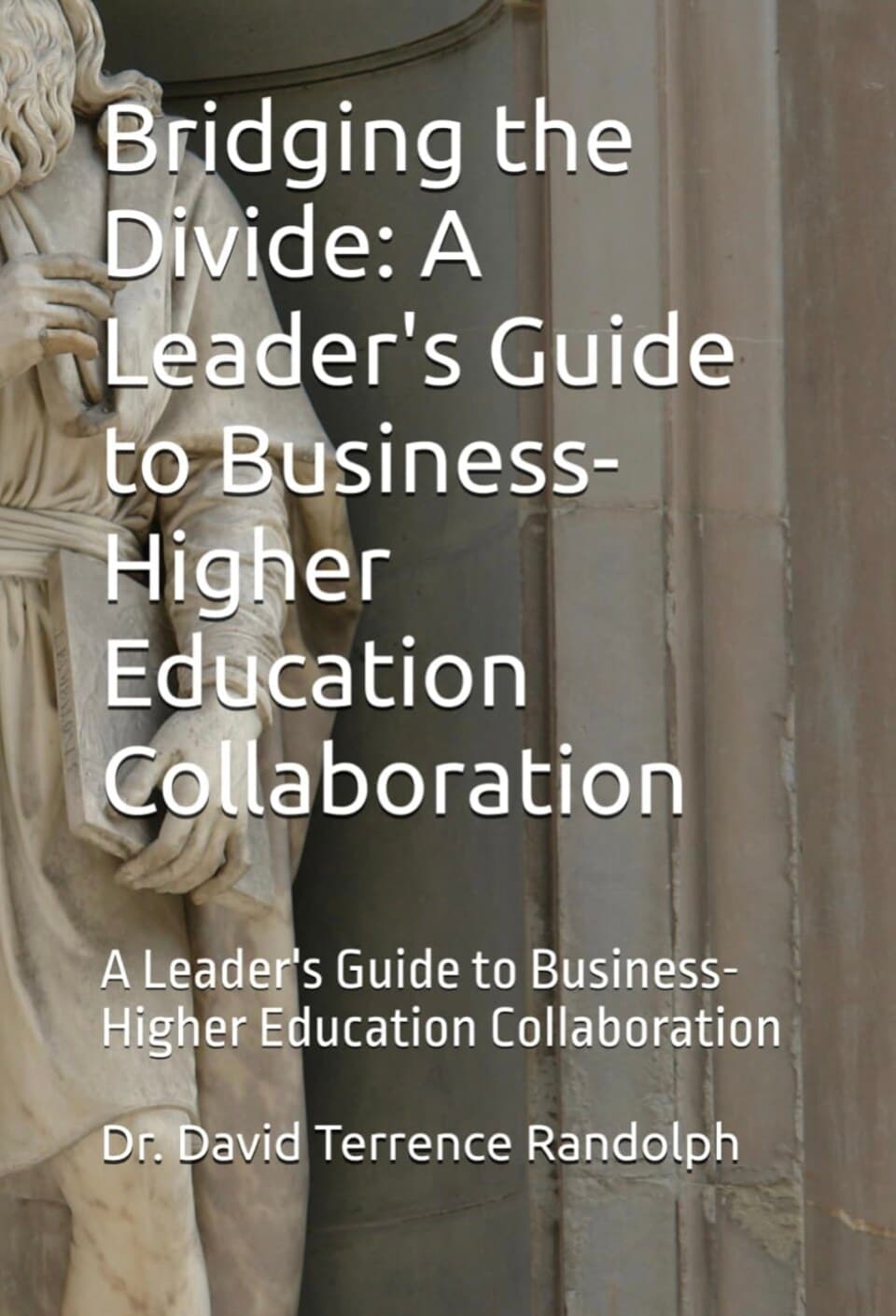
Paperback & Kindle eBook · 6 × 9 in
Why Leonardo da Vinci is on the cover
Get the Book on Amazon- Author
- Dr. David Terrence Randolph
- Publication Year
- 2026
- Edition
- First Edition
- Formats
- Kindle eBook & Paperback
- Availability
- Paperback and Kindle eBook on Amazon.com
- Extent
- 200 pages · 6 × 9 in
- Structure
- 18 chapters · 5 appendices
- Research Basis
- Doctoral research, Dunster Business School, Switzerland
The difference was never the size of the check.
Every year, university leaders sign business partnerships that look nearly identical on paper — and produce opposite results in practice.
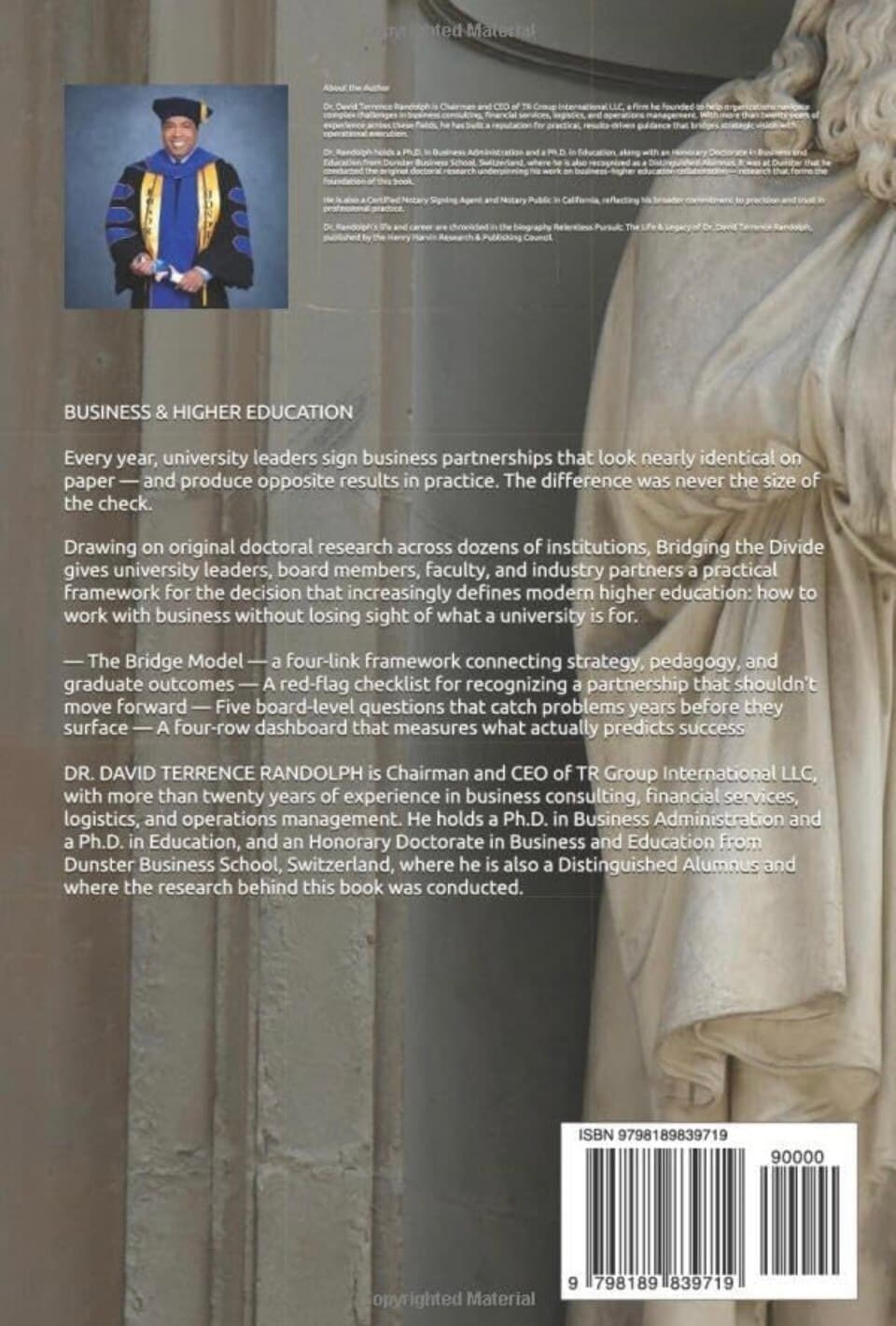
Drawing on original doctoral research across dozens of institutions, Bridging the Divide gives university leaders, board members, faculty, and industry partners a practical framework for the decision that increasingly defines modern higher education: how to work with business without losing sight of what a university is for.
- Strategies for building sustainable university-business partnerships
- Best practices for workforce development and talent pipelines
- Leadership frameworks for cross-sector collaboration
- Practical recommendations for educators, executives, and public leaders
- Insights to strengthen organizational performance while preparing future generations
The same research, written for a different reader.
This book began as a doctoral thesis: a close, careful study of how business engagement moves through higher education institutions, examined through interviews with academic leaders and faculty, analysis of institutional strategy documents, and a structured survey of graduates across multiple institutions.
This is the same research, written for the university leader, board member, or policymaker who doesn’t have three months to read a dissertation, but does have a partnership decision to make this quarter. Every finding traces back to that original research — the framework, the checklist, and the language are new; the evidence underneath them is not.
The honest answer to “should my institution partner with business?” was never going to be yes or no. It was always going to be: it depends, and here is exactly what it depends on.
Dr. David Terrence Randolph
Chairman & CEO, TR Group International LLC
Distinguished Alumnus, Dunster Business School, Switzerland
Why Leonardo da Vinci stands on the cover.
The inclusion of Leonardo da Vinci on the cover of Bridging the Divide is both intentional and deeply symbolic. Leonardo da Vinci is universally recognized as one of the greatest minds in human history and serves as an enduring symbol of intellectual excellence, innovation, creativity, leadership, and the limitless potential of human achievement.
His presence on the cover reflects the central themes of this book and reinforces its mission of fostering meaningful collaboration between higher education and the business community.
The choice of a statue, rather than a painted portrait, carries additional significance. A statue symbolizes permanence, strength, honor, achievement, respect, dignity, wisdom, and enduring influence. It reflects the idea that the principles presented in this book are intended to withstand the test of time and serve as a lasting guide for leaders committed to advancing collaboration between higher education and business.
- 01
Unity of Knowledge
Leonardo da Vinci believed that knowledge should never exist in isolation. Throughout his life, he seamlessly integrated art, science, engineering, mathematics, anatomy, architecture, philosophy, and observation into a unified approach to learning. His ability to connect diverse disciplines mirrors the central premise of this book: that higher education and business must work together rather than operate as separate entities. Innovation flourishes when disciplines intersect and collaborate.
- 02
Innovation
Leonardo is perhaps history’s greatest symbol of innovation. His visionary concepts and groundbreaking ideas transformed the way humanity understands creativity, engineering, and scientific discovery. Likewise, this book encourages leaders to challenge conventional thinking, embrace innovation, and create partnerships that prepare organizations and educational institutions to solve the complex challenges of the future.
- 03
Lifelong Learning
Leonardo never stopped learning. He continually studied nature, filled notebooks with observations, conducted experiments, and sought knowledge in every aspect of life. His relentless curiosity exemplifies the principle that education is a lifelong pursuit. This book advocates for organizations that cultivate continuous learning, professional development, and intellectual growth throughout one’s career.
- 04
Visionary Leadership
Great leaders possess the ability to see possibilities long before others recognize them. Leonardo envisioned flying machines, advanced engineering systems, and technological innovations centuries ahead of their time. Similarly, this book encourages leaders to look beyond existing structures and imagine new possibilities through strategic collaboration between higher education and industry.
- 05
Creativity Combined with Practical Application
Leonardo united artistic creativity with practical problem-solving. His work demonstrates that imagination and execution are not opposing forces but complementary strengths. Business focuses on implementation and results, while higher education emphasizes discovery and research. This book promotes the integration of both perspectives to produce innovative and practical solutions that benefit society.
- 06
Excellence
For more than five centuries, Leonardo da Vinci has represented the highest standards of excellence. His name is synonymous with mastery, scholarship, discipline, precision, and intellectual achievement. His image on the cover communicates that the ideas presented in this book aspire to those same enduring standards of quality and professional excellence.
- 07
Curiosity
Curiosity was the driving force behind Leonardo’s remarkable accomplishments. He constantly questioned accepted beliefs, explored new ideas, and sought deeper understanding. This same spirit of inquiry is essential for leaders seeking to strengthen relationships between higher education and business. Meaningful collaboration begins with asking thoughtful questions and remaining open to new perspectives.
- 08
Systems Thinking
Leonardo rarely viewed subjects in isolation. Instead, he understood how individual components interacted within larger systems. This systems-thinking approach reflects the framework presented throughout this book, which explores the interconnected relationships among education, business, leadership, workforce development, innovation, economic growth, and public policy.
- 09
Human Potential
Leonardo believed that human beings possess extraordinary potential when they pursue knowledge with discipline, purpose, and perseverance. This book likewise emphasizes developing individuals through education, leadership, collaboration, mentorship, and lifelong learning so they may achieve their fullest potential while contributing positively to society.
- 10
Renaissance Thinking
The Renaissance represented one of history’s greatest periods of intellectual awakening, characterized by breaking down barriers between disciplines and encouraging collaboration among scholars, artists, scientists, engineers, and civic leaders. In the same spirit, this book advocates removing traditional barriers between higher education and the business community to foster innovation, shared learning, and mutual success.
- 11
Wisdom
The statue of Leonardo da Vinci conveys permanence, stability, maturity, and wisdom. Rather than representing temporary trends or passing ideas, it symbolizes timeless principles that continue to guide leadership, scholarship, and human progress. The book similarly presents enduring concepts intended to remain relevant for future generations.
- 12
Legacy
More than five hundred years after his death, Leonardo da Vinci continues to influence science, education, engineering, art, medicine, architecture, and innovation throughout the world. His legacy reminds readers that truly meaningful work extends far beyond one’s lifetime. This book encourages leaders to build enduring partnerships and create lasting contributions that strengthen educational institutions, businesses, communities, and society as a whole.
Leonardo da Vinci serves as a powerful visual metaphor for the message of this book. His life demonstrates that extraordinary achievements occur when knowledge is integrated across disciplines, curiosity is encouraged, innovation is embraced, and learning never ceases. His image communicates intellectual excellence, visionary leadership, creativity, strategic thinking, lifelong learning, interdisciplinary collaboration, scholarship, and the pursuit of human potential.
Ultimately, the presence of Leonardo da Vinci on the cover symbolizes the book’s central message: that the future belongs to leaders who are willing to bridge traditional divides, unite diverse fields of knowledge, foster meaningful collaboration, and create innovative solutions that benefit organizations, educational institutions, communities, and society for generations to come.
The Bridge Model — four links, two lenses.
Every leader in this space is already running some version of an internal model — a rough sense of how a partnership decision made at the top eventually shows up in a graduate’s résumé. Most are informal, untested, and built more on instinct than evidence. The book puts a name and a structure to that model, so it can be used deliberately instead of by accident.
- 01
Institutional Strategy & Governance
The starting point — mission statements, strategic plans, funding priorities, and who actually holds a seat at the table when partnership decisions get made.
- 02
Engagement Models
The mechanism — curriculum co-design, internships, sponsored research, micro-credentials, consulting arrangements, ed-tech partnerships. Naming honestly how much control each one hands to an outside party.
- 03
Pedagogy & Curriculum
The translation point, where strategy either survives contact with the classroom or does not. Faculty interpret, adapt, and sometimes quietly resist reforms handed down from above.
- 04
Graduate Outcomes
Where it all lands — not just placement rates, but skill utilization, adaptability, and career trajectory over years. The only link most institutions actually measure, which is precisely the problem.
Equity & Access
Who was in the room when the partnership was designed, and who gets the internship, the sponsored placement, the seat in the cohort. Left unmanaged, business engagement does not distribute its benefits evenly — it tends to reward students who already had resources, networks, or geography on their side.
Academic Autonomy & Values
How much say faculty retain over what and how they teach once an outside partner is involved. Autonomy is not an all-or-nothing switch but a spectrum from light consultation to functional control — and most institutions sit further along it than their leadership realizes.
The instinctive way to think about business engagement is a straight line: partner with industry, improve curriculum, improve employability. The evidence doesn’t support that line — the four links feed back into each other rather than running one way, which means treating the system as linear leads to fixing the wrong link.
Built to be read by role.
The book is written to be read cover to cover, but it is also built so that different readers can move straight to what matters most to the seat they sit in.
Presidents, provosts & deans
The full argument, in order — the framework is the lens the findings chapters use.
Board members & trustees
A distinct, shorter set of higher-leverage questions written for the oversight role.
Industry partners
The partner’s own seat at the table, and what makes a collaboration worth signing.
Faculty
The pedagogical and autonomy questions a partnership actually puts in front of a department.
Leadership teams
A discussion guide organized by chapter cluster, built for reading groups.
18 chapters, 5 appendices.
From why the question matters now, through what the research found at each link, to a working playbook, a red-flag checklist, and a short dashboard for measuring it all.
- 01Why This Matters Now
- 02The State of Play
- 03A Framework Leaders Can Use
- 04What the Data Shows: Strategy and Governance
- 05What the Data Shows: Pedagogy
- 06What the Data Shows: Graduate Outcomes
- 07The Equity and Autonomy Test
- 08Voices from the Field
- 09What It Means
- 10What to Do About It
- 11A Playbook for Leaders
- 12How This Plays Out by Institution Type
- 13Questions Boards Should Ask
- 14The Industry Partner’s Playbook
- 15Red Flags: When to Walk Away
- 16Measuring What Matters
- 17What Comes Next
- 18The Bridge, Revisited
- AHow This Research Was Done
- BFurther Reading
- CDiscussion Guide for Leadership Teams
- DIllustrative Findings Patterns
- EGlossary of Key Terms
The scholarship underneath.
This trade edition is adapted from original doctoral research conducted at Dunster Business School, Switzerland. The underlying dissertation remains published and citable in its own right, with the full research design, sampling, and analysis methods documented in Appendix A of the book.
10.5281/zenodo.20480280Business–Higher Education Collaboration and Its Impact on Strategy, Pedagogy, and Graduate Employability
Version 2.0 · DOI 10.5281/zenodo.20480280
Randolph, D. T. (2026). Bridging the Divide: A Leader’s Guide to Business–Higher Education Collaboration (1st ed.).
Read alongside Principles of Leadership, Resilience, and Purpose and the official biography Relentless Pursuit, it completes a written record built at the intersection of business leadership and education.

More from the written record.
Explore the full publication record and executive profile, or reach out to discuss an engagement with Dr. David T. Randolph.
- Telephone
- 747-208-2074
- Coverage
- Greater Los Angeles County