
Leadership in an Age of Uncertainty: Restoring Accountability, Strategic Judgment, Institutional Trust, and the Courage to Serve
The Randolph Report: A Monthly Publication of TR Group International LLC
From the Desk of Dr. David Terrence Randolph
Chairman & CEO, TR Group International LLC
Award-Winning Author, Writer, Researcher, and Executive Business Consultant

Leadership Must Be Measured by Responsibility, Not Authority

The defining challenge confronting contemporary leadership is not simply the accelerating pace of technological innovation, economic uncertainty, political disagreement, or institutional transformation.
It is the growing distance between the authority individuals possess and the responsibility they demonstrate.
Organizations have become increasingly sophisticated in their technologies, financial instruments, administrative systems, and strategic planning capabilities. Yet sophistication does not automatically produce wisdom.
Access to information does not guarantee sound judgment. Institutional prestige does not establish integrity. And the possession of executive authority does not necessarily signify the capacity to lead.
Leadership must be understood as a responsibility that extends beyond personal advancement, organizational performance, and the accumulation of professional recognition. Its ultimate legitimacy depends upon how authority is exercised, the quality of the decisions made, the treatment of the people those decisions affect, and the enduring consequences of institutional action.
In my assessment, the central question facing executives is no longer merely whether they can manage complexity. It is whether they possess the character, intellectual discipline, and moral courage to manage complexity without compromising the principles that make leadership worthy of public confidence.
The distinction is consequential.
A successful executive may produce favorable financial results. An effective institutional steward must also ask whether those results were achieved responsibly, whether the organization remains resilient, and whether its long-term interests have been preserved.
Throughout more than two decades of work in business consulting, financial services, logistics, and operations management, I have observed a consistent pattern. Organizations rarely fail because their leaders lacked information. They fail because information was ignored, concerns were dismissed, accountability was applied selectively, or short-term advantage was allowed to override long-term responsibility.
I have seen capable organizations weakened not by external competition but by internal habits: decisions made without consultation, warnings delivered and then quietly set aside, and standards enforced rigorously at the lower levels of the organization while remaining optional at the top. None of these failures announced themselves at the time. Each appeared reasonable in the moment. Together, they eroded the confidence that every institution depends upon.
The lesson is not that leaders must be perfect. It is that leaders must be accountable: consistently, visibly, and without exception, including for their own conduct.
Leadership cannot be reduced to quarterly earnings, professional titles, public appearances, or carefully constructed reputations.
Leadership is demonstrated through conduct.
It is revealed when circumstances become unfavorable, when difficult decisions must be made, when institutional interests conflict with personal ambitions, and when accountability demands more than a public statement.
The November edition of The Randolph Report examines these challenges through the interconnected disciplines of executive leadership, strategic judgment, organizational resilience, institutional trust, and responsible stewardship.
Its central argument is straightforward:
The future of leadership will depend less upon the concentration of authority and more upon the disciplined, accountable, and principled exercise of that authority.
The Institutional Trust Deficit: Why Leadership Credibility Has Become a Strategic Imperative

Institutional trust is among the most valuable yet frequently misunderstood assets available to an organization.
It cannot be manufactured through advertising campaigns, purchased through consulting arrangements, or permanently secured through an impressive corporate history.
Trust develops through repeated demonstrations of competence, fairness, honesty, and consistency. It can also deteriorate rapidly when organizational behavior contradicts institutional commitments.
Recent research illustrates the seriousness of this challenge.
In August 2026, Gallup found that only 19 percent of U.S. employees strongly agreed that they trust their organization’s leadership. Employees who did were 3.7 times as likely to be engaged at work.
The broader public picture is similar. Gallup’s June 2026 survey found that Americans’ average confidence across 14 major institutions stands at 27 percent, just one point above the record low recorded in 2023.
Yet the 2026 Edelman Trust Barometer offers an important counterpoint. Among employees surveyed across 28 countries, 78 percent said they trust their own employer, which makes the employer the most trusted institution in the study.
Read together, these findings reveal an important pattern.
People have not abandoned trust. They have withdrawn it from distant institutions and placed it closer to home, with the organizations where they work every day. That places an extraordinary responsibility upon executives.
Edelman’s research identifies the gap precisely. Seventy-five percent of respondents said chief executives are obligated to help bridge divides and build trust. Only 44 percent said chief executives are actually doing it well.
That 31-point distance is not a communications problem. It is a leadership problem.
Executives often assume that trust problems originate elsewhere: in public opinion, in political division, or in media coverage. Those forces are real. But the research suggests that the most decisive trust relationship in an employee’s life is the one with the organization that employs them. That relationship is shaped far less by national events than by the daily conduct of leadership.
When employees see leaders explain their reasoning, honor their commitments, and accept responsibility for their mistakes, trust grows. When they see the opposite, no communications strategy can repair the damage.
The implications are significant.
An organization cannot reasonably expect sustained commitment from employees who lack confidence in the judgment, integrity, or intentions of those responsible for directing its future. Similarly, stakeholders cannot be expected to maintain confidence in institutions that consistently substitute public relations for accountability.

The problem extends beyond individual executives.
Institutional trust is influenced by governance arrangements, decision-making procedures, organizational culture, communication practices, and the extent to which leadership demonstrates consistency between stated values and observable conduct.
Consider an organization that publicly emphasizes transparency while withholding essential information from employees.
Consider a corporation that promotes accountability while allowing senior executives to escape consequences imposed upon subordinate personnel.
Consider an institution that celebrates innovation but discourages thoughtful disagreement.
Each example reveals a fundamental contradiction between institutional identity and operational reality.
These contradictions create what may be described as a credibility deficit: the distance between what an organization claims to represent and what its stakeholders actually experience.
Addressing this deficit requires more than improved messaging. It requires structural accountability.
Executives must establish decision-making processes that can withstand scrutiny, performance standards that apply consistently across organizational hierarchies, and mechanisms through which concerns can be raised without fear of retaliation.
Leaders should also recognize that trust is measured locally. Employees rarely form their judgment of an institution from its annual report or its public statements. They form it from the conduct of the managers they work with each day, the fairness of the decisions that affect them, and whether promises made in difficult times are honored when conditions improve. Every executive decision, however distant from the front line, eventually reaches someone who must decide whether to believe in the organization that made it.
Trust also requires leaders to acknowledge uncertainty.
An executive who admits that additional information is necessary may demonstrate greater judgment than one who projects confidence unsupported by evidence.
The willingness to acknowledge limitations is not a sign of leadership weakness. It is frequently evidence of intellectual maturity.
Strategic Judgment: The Discipline of Making Decisions Under Uncertainty

Strategic decision-making is often presented as a technical process involving information collection, financial modeling, competitive analysis, and the selection of alternatives.
These elements are essential, but they are insufficient.
The quality of strategic judgment depends not only upon the information available but also upon the assumptions executives make, the perspectives they consider, and their willingness to challenge established beliefs.
Poor strategic decisions frequently emerge from predictable organizational conditions: excessive confidence, limited consultation, inadequate risk evaluation, compressed decision timelines, and the suppression of dissenting viewpoints.
These conditions become particularly dangerous when executive authority discourages constructive disagreement. In such environments, the most important information in the organization may never reach the person responsible for the decision.
Organizations must therefore distinguish decisiveness from impulsiveness.
Decisiveness reflects the capacity to act after evaluating available evidence, recognizing uncertainty, and considering consequences.
Impulsiveness substitutes speed for discipline.
An effective executive must know when immediate action is required and when restraint represents the more responsible course. This distinction becomes especially important during financial distress, institutional restructuring, reputational crises, and technological transformation.
Consider a familiar scenario. A leadership team, under pressure to demonstrate growth, commits substantial capital to an acquisition within weeks. Due diligence is compressed. Integration risks are noted but not examined. Concerns raised by operational managers are characterized as resistance to change.
Twelve months later, the anticipated synergies have not materialized, key personnel have departed, and the organization is absorbing costs no one formally evaluated.
The failure was not a lack of intelligence. It was a lack of discipline.
The same pattern appears in smaller decisions. A new technology platform is purchased before the problem it is meant to solve has been defined. A reorganization is announced before anyone has asked how work actually flows through the organization. A price increase is implemented without considering how long-standing customers will interpret it.
In each case, the decision may be defensible in principle. The failure lies in the process that produced it. Strategic discipline is not about slowing every decision. It is about ensuring that the most consequential decisions receive the scrutiny their consequences deserve.

The responsible leader asks several questions before committing organizational resources:
- 1. What problem are we actually attempting to solve?
- 2. Which assumptions are supported by evidence?
- 3. What information remains unavailable?
- 4. Who will bear the consequences if the decision proves unsuccessful?
- 5. What alternatives have been considered?
- 6. How will the organization determine whether the decision achieved its intended purpose?
These questions should not be interpreted as bureaucratic obstacles. They are instruments of strategic discipline.
An organization that cannot explain the rationale for its most consequential decisions has a governance problem, regardless of whether those decisions ultimately produce favorable outcomes.
A favorable outcome reached through poor reasoning is not evidence of good judgment. It is evidence of good fortune, and fortune is not a strategy.
Resilience Is Not the Absence of Adversity

Resilience is frequently misunderstood as an individual’s ability to tolerate difficult circumstances without complaint.
This interpretation is incomplete.
Organizational resilience is better understood as the capacity to anticipate disruption, absorb operational stress, adapt to changing conditions, and preserve essential institutional functions.
Resilience therefore requires preparation rather than optimism alone.
An organization that depends entirely upon the uninterrupted performance of one executive, one technology provider, one revenue source, or one operational process may appear efficient during favorable circumstances while remaining structurally vulnerable.
My own experience in logistics and operations management has reinforced this lesson repeatedly. The supply chain that appears most efficient on paper is often the one with no margin for disruption. When a single supplier fails, a single route closes, or a single system goes offline, the cost of that efficiency becomes visible all at once.
The responsibility of leadership is to identify these vulnerabilities before they become crises.
Resilient institutions establish operational safeguards, develop succession plans, diversify critical dependencies, preserve financial flexibility, and cultivate employees capable of exercising independent judgment.
Resilience also depends upon honest assessment. Many organizations conduct risk reviews that confirm what leadership already believes. A genuine resilience review asks harder questions. What happens if our largest customer leaves? What happens if a key executive is unavailable for three months? What happens if our primary system fails during our busiest period? Which of our assumptions about the coming year are we least prepared to see proven wrong?
Organizations that ask these questions in calm periods are far better prepared to answer them in difficult ones.
Resilient institutions also recognize that organizational resilience has a human dimension.
Gallup reports that only 31 percent of U.S. employees were engaged at work as of May 2026. Employees cannot continuously absorb expanding responsibilities, inconsistent direction, and organizational uncertainty without consequences.
Leadership must distinguish productive perseverance from institutional exhaustion.
There is no strategic virtue in maintaining an unsustainable operating model merely because employees have demonstrated the willingness to endure it.
Resilience requires the courage to redesign systems that no longer serve their intended purpose. It also requires leaders to recognize when organizational traditions have become barriers to necessary change.
Restoring the Relationship Between Knowledge, Leadership, and Institutional Purpose

The relationship between business and higher education deserves renewed executive attention.
Universities contribute research, intellectual development, professional preparation, and the advancement of knowledge. Businesses contribute practical application, organizational resources, economic opportunity, and the experience of operating within competitive environments.
Neither sector can fully realize its broader institutional potential when it operates in isolation from the other.
The need is urgent. Recent Gallup polling places public confidence in higher education at 38 percent. Universities and employers alike have a stake in demonstrating that education produces measurable value.
Employers, for their part, frequently report difficulty finding candidates prepared for the realities of modern organizations: complex decision-making, ethical judgment, collaborative problem-solving, and the responsible use of technology. These are not deficiencies that either sector can resolve alone. They require sustained cooperation between the institutions that educate future leaders and the institutions that will ultimately employ them.
Yet effective collaboration requires more than ceremonial partnerships, occasional conferences, or generalized commitments to workforce development.
It requires clearly defined objectives, reciprocal accountability, and an understanding of the different responsibilities carried by academic and corporate institutions.
Higher education must preserve intellectual independence and academic integrity. Business organizations must maintain operational discipline, economic viability, and responsibility to their stakeholders.
Productive collaboration emerges when these responsibilities are respected rather than subordinated to one another.
Opportunities include applied research, executive education, professional development, ethical technology implementation, leadership preparation, and the development of organizational capabilities.
Consider what a disciplined partnership looks like in practice. A regional employer and a university agree on a specific capability gap, such as supply chain analytics or operations leadership. Faculty design the curriculum with input from experienced practitioners. The employer commits to internships, project work, and hiring consideration. Both parties agree in advance on how success will be measured, whether through graduate placement, applied research outcomes, or measurable improvements in organizational performance, and both review those results each year.
Such an arrangement is neither ceremonial nor one-sided. It is accountable to both institutions and, most importantly, to the students it serves.
The objective should not be to transform universities into extensions of corporate interests. Nor should businesses be expected to abandon practical considerations in pursuit of purely theoretical objectives.
The objective is institutional complementarity: the responsible integration of distinct strengths toward clearly established purposes.
As discussed in my work Bridging the Divide: A Leader’s Guide to Business–Higher Education Collaboration, sustainable cooperation requires more than agreement about desirable outcomes. It requires governance structures, mutual respect, measurable commitments, and a willingness to confront institutional differences.
Artificial Intelligence Cannot Replace Executive Accountability

Artificial intelligence is changing the way organizations analyze information, deliver services, manage operations, and formulate strategic alternatives.
Its capabilities create meaningful opportunities for productivity, research, and administrative improvement.
However, technological sophistication should not be confused with institutional judgment.
Public confidence reflects this tension. Gallup’s June 2026 survey found that confidence in large technology companies has fallen to 20 percent, a new low and down from 32 percent when Gallup first measured it in 2020.
An automated system may assist an executive in evaluating alternatives. It cannot assume the executive’s moral or professional responsibility for the consequences of a decision.
This distinction must remain central to organizational governance.
Executives should resist the temptation to treat algorithmic recommendations as substitutes for independent evaluation. Technology can process information at extraordinary speed while still producing incomplete, misleading, or inappropriate outputs.
The risk is not only that a system may be wrong. It is that people may stop asking whether it is wrong. When an automated recommendation arrives with apparent precision, it can discourage the very questioning that sound judgment requires. Leaders must therefore cultivate a culture in which challenging an algorithm is treated as responsible diligence rather than resistance to progress.

The responsible implementation of artificial intelligence therefore requires human oversight, data governance, cybersecurity safeguards, defined accountability, and procedures for evaluating errors.
Organizations should also consider the consequences of technological adoption for employees and customers.
Efficiency gains are important. But efficiency achieved through inadequate oversight, unnecessary exposure of confidential information, or the erosion of essential human judgment may generate costs that exceed the immediate benefits.
When an automated decision harms a customer or an employee, the public will not ask which algorithm was responsible. It will ask which leader was.
Practical governance begins with a few clear commitments. Every significant use of artificial intelligence should have a named executive owner. Decisions that materially affect employment, credit, health, safety, or legal rights should require meaningful human review. Data used to train or operate these systems should be documented, protected, and periodically audited. And employees should know when automated tools are being used in decisions that affect them.
These commitments do not slow innovation. They make innovation sustainable, because they allow an organization to explain and defend its use of technology when questions inevitably arise.
The central question is not whether artificial intelligence should participate in executive decision-making. It is how organizations can use its capabilities while preserving human responsibility.
Character, Courage, and the Responsibility to Serve

Leadership ultimately confronts a question that no organizational chart, financial statement, or strategic planning document can fully resolve:
What kind of responsibility does a person accept when entrusted with authority over others?
My perspective is that leadership must be grounded in character before it can be sustained through competence.
Competence without integrity creates institutional risk.
Authority without accountability creates the conditions for abuse.
Ambition without restraint can transform organizational leadership into personal self-promotion.
And strategic intelligence without concern for human consequences can produce technically sophisticated yet fundamentally irresponsible decisions.
Courage is therefore indispensable. But courage should not be confused with aggression, inflexibility, or an unwillingness to reconsider established positions.
The courage to lead includes the willingness to acknowledge mistakes, confront uncomfortable evidence, defend legitimate principles, and make necessary changes when circumstances demand them.
It also includes the courage to serve.
Service requires leaders to recognize that their responsibilities extend beyond themselves. Executives are custodians of institutional resources, organizational relationships, professional opportunities, and the trust placed in them by others.
Over the course of my career, the leaders I have most respected were rarely the loudest voices in the room. They were the ones who listened before deciding, who credited others when results were favorable, and who accepted responsibility personally when results were not. They understood that a title confers authority, but only conduct confers respect.
Service also requires attention to those who are least visible within an organization: the employee whose concern has not been heard, the customer whose complaint has not been resolved, and the community affected by decisions made far from its view. Leadership that serves only those with influence is not service. It is accommodation.
These responsibilities should be exercised with discipline and humility.
The enduring measure of leadership is not simply what an individual accomplishes while holding authority. It is what remains stronger, more capable, more ethical, and more resilient because that authority was exercised responsibly.
Five Priorities for Responsible Leadership

- 1. Reestablish institutional credibility. Conduct a candid assessment of whether organizational practices reflect stated values. Identify contradictions and establish measurable corrective actions.
- 2. Strengthen decision-making discipline. Require significant strategic decisions to include documented assumptions, risk assessments, alternative scenarios, and clearly identified accountability.
- 3. Invest in organizational resilience. Review operational dependencies, succession arrangements, workforce sustainability, and the institution’s capacity to respond to disruption.
- 4. Protect the human dimension of technological transformation. Implement technology with appropriate oversight, transparent communication, and explicit consideration of its consequences for employees and stakeholders.
- 5. Reaffirm the responsibility of institutional stewardship. Evaluate executive performance not only through immediate financial outcomes but also through long-term organizational health, ethical conduct, institutional trust, and sustainable value creation.
These priorities are not intended as temporary responses to uncertainty.
They represent enduring obligations of responsible leadership.
The Future Belongs to Leaders Who Accept Responsibility

The contemporary world does not suffer from a shortage of individuals seeking authority.
It suffers from an insufficient commitment to the responsibilities that legitimate authority demands.
Organizations require leaders capable of thinking beyond immediate advantage, resisting unnecessary complexity, and making decisions grounded in evidence, character, and institutional purpose.
They require executives who understand that resilience is developed before adversity, that trust is earned through conduct, and that accountability must extend to those occupying the highest positions of authority.
Above all, they require individuals who recognize that leadership is not an entitlement.
It is a responsibility.
The most consequential contribution of a leader may not be a financial achievement, a public recognition, or a period of professional prominence.
It may be the creation of an institution that continues to demonstrate integrity, sound judgment, and responsible stewardship long after that leader’s tenure has concluded.
As this year draws to a close, I encourage every executive reading this report to pause and ask a few honest questions. Which commitments did my organization keep this year, and which did it allow to lapse? Where did we choose convenience over accountability? And what would the people who depend on our decisions say about the way we exercised our authority?
The answers may be uncomfortable. They are also the beginning of better leadership in the year ahead.
May the coming year be one of renewed purpose, sound judgment, and responsible leadership.
Leadership is temporary. Responsibility is enduring. Institutional legacy is the consequence of both.
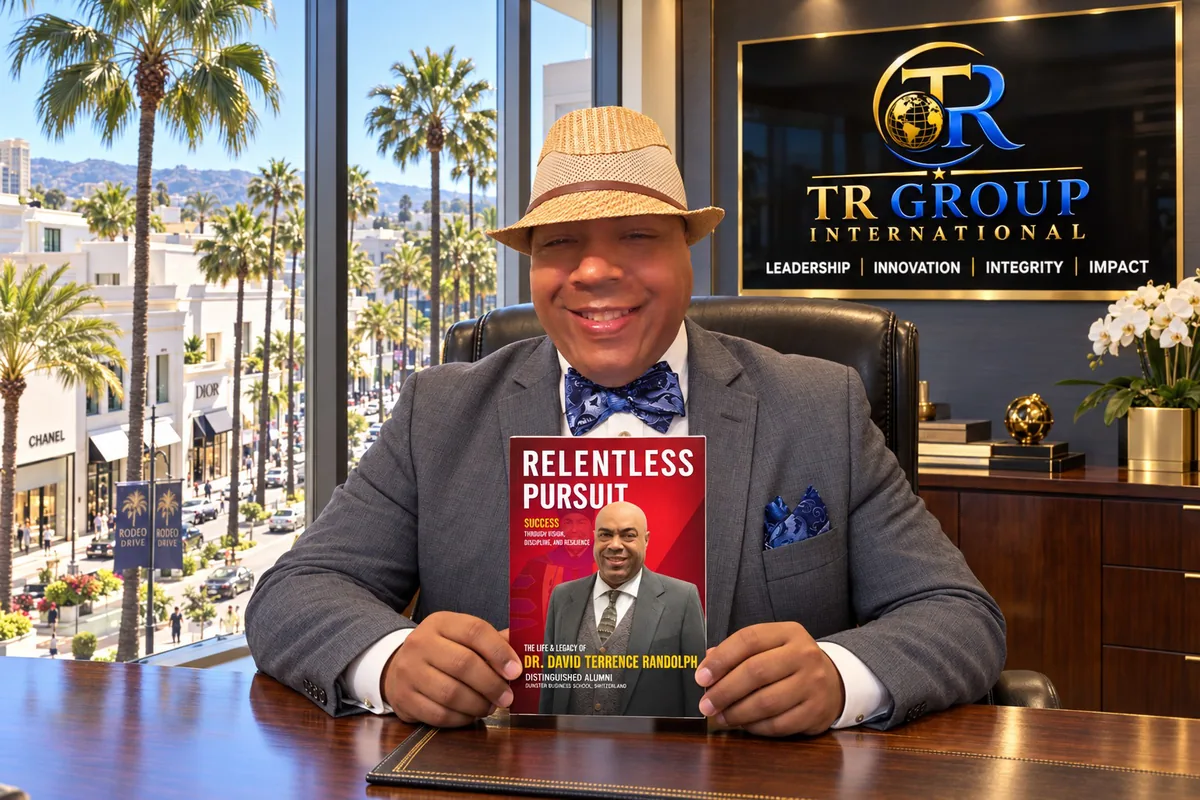
Dr. David Terrence Randolph is an award-winning author, writer, researcher, executive business consultant, and Chairman & CEO of TR Group International LLC.
He holds a Ph.D. in Business Administration, a Ph.D. in Education, and an Honorary Doctorate in Business and Education.
He received the 2026 Global Recognition Award for Excellence in Leadership.
His published works include:
- Principles of Leadership, Resilience, and Purpose: Selected Quotations
- Bridging the Divide: A Leader’s Guide to Business–Higher Education Collaboration
- The Strategic Executive: An Integrated Framework for Purpose, Judgment, and Institutional Stewardship
- The Age of Fragmented Leadership: Restoring Coherence, Character, and Stewardship in a Divided World
His professional and scholarly interests include executive leadership, strategic judgment, organizational resilience, institutional accountability, business strategy, and the relationship between higher education and organizational development.
TR Group International LLC
www.trgroupinternational.com
The Randolph Report is an independent executive commentary and research publication. Editorial interpretations and recommendations represent the publisher’s professional analysis.
Gallup. (2026). Leadership & Management Indicator. August 2026 data.
Gallup. (2026). Employee Engagement Indicator. May 2026 data.
Gallup. (2026, July 13). Confidence in U.S. Institutions Remains Near All-Time Low. Survey conducted June 1–15, 2026.
Gallup. (2026). Public confidence in higher education. 2026 polling data.
Edelman. (2026). 2026 Edelman Trust Barometer. Research examining institutional trust, insularity, and the responsibilities of business leadership.
Edelman. (2026). Trust at Work. Research concerning organizational change, employee confidence, and workplace trust.
Randolph, David Terrence. The Strategic Executive: An Integrated Framework for Purpose, Judgment, and Institutional Stewardship.
Randolph, David Terrence. The Age of Fragmented Leadership: Restoring Coherence, Character, and Stewardship in a Divided World.
Randolph, David Terrence. Bridging the Divide: A Leader’s Guide to Business–Higher Education Collaboration.
© 2026 TR Group International LLC. All rights reserved.
The Randolph Report arrives once a month. Earlier issues remain available to read in full.

Prefer to speak directly?
The Report is one way to stay in touch; a conversation is another. Every engagement begins with a single, careful conversation, directly with the principal, with no obligation.
- Telephone
- 747-208-2074
- Coverage
- Greater Los Angeles County