
Recognition, Responsibility, and the Continuing Work of Leadership
The Randolph Report, October 2026 · By Dr. David Terrence Randolph

Dear Readers,
I am pleased to share that I received a 2026 Global Recognition Award in Leadership for my cross-border advisory work through TR Group International LLC.
An occasion like this invites celebration, but it also invites reflection. What does recognition ask of the person receiving it? How should increased visibility shape our decisions, commitments, and treatment of others?
What must remain consistent when circumstances change, and the attention surrounding an achievement eventually fades?
These questions reach beyond awards. They concern anyone entrusted with influence: an executive directing an organization, an educator preparing students, a consultant advising a client, or a person whose daily example affects a family or community.
Leadership carries consequences because other people live with the results of our choices.
In this expanded edition, I explore the responsibilities that accompany recognition, offer a practical approach to difficult decisions, and connect these themes with my four published books and my presentation, Leadership Beyond the Title.
My purpose is to make the discussion useful wherever you exercise influence.


Leadership Beyond the Title
A title identifies a position. The quality of leadership emerges through conduct: how decisions are made, how commitments are honored, and how people are treated when their interests conflict with our own.
Consider an executive facing disappointing results. One response is to demand faster execution without examining whether the original plan was realistic.
Another is to investigate the assumptions, listen to those responsible for implementation, and explain what will change. The second response requires the leader to accept scrutiny alongside authority.
The same test appears in smaller settings. A team member raises an uncomfortable concern. A colleague disagrees with a favored proposal.
A customer describes a failure that contradicts the organization’s preferred account of its performance. Each encounter offers a choice about whether listening will influence action.
Strong leadership makes room for informed disagreement. It separates challenges to an idea from attacks on a person. It also establishes expectations clearly enough that accountability does not depend on guessing what the leader wants.
These habits give confidence substance. People can trust a leader who explains the reasoning behind a decision, acknowledges uncertainty, and returns to unresolved questions.
They can work more effectively when correction is possible without humiliation.
Recognition should deepen that discipline. An award does not remove the obligation to listen, learn, or reconsider. It makes those obligations more visible.
Stewardship: What Will Remain After the Decision?
Stewardship begins with the understanding that leadership places something valuable in our care.
An organization’s resources, its professional relationships, its institutional knowledge, and the trust of its people deserve protection.
The immediate result of a decision may be attractive while its longer consequences remain costly.
Reducing expenditure can weaken capabilities that take years to rebuild. Pursuing growth can overwhelm systems that were designed for a smaller operation.
Introducing a new initiative can consume the attention required to fulfill existing commitments. Responsible ambition examines those consequences before asking others to absorb them.
Leaders need to understand what their plans require, which capabilities already exist, and where additional support is necessary. They must also decide what will receive less attention when a new priority is introduced.
For example, a business expanding into another market should examine more than potential demand. It should consider operational capacity, communication, local expectations, and the support required by the people responsible for delivery.
A promising opportunity becomes a credible strategy when its demands are understood. Stewardship also concerns succession. If an organization functions only when one individual intervenes, its apparent strength may conceal fragility.
Documenting decisions, developing others, and sharing knowledge help preserve continuity. A useful leadership question is therefore: What will this decision leave stronger, and what might it leave more vulnerable?
Answering honestly connects today’s ambition with tomorrow’s responsibility.

Accountability: Turning Commitments into Evidence
Accountability becomes practical when people can distinguish a commitment from a general intention. Statements such as improving communication or strengthening collaboration express direction, but they leave essential questions unanswered.
What will change? Who will take responsibility? When will progress be reviewed? What evidence will show whether the action helped? Without those details, even sincere commitments can disappear into competing demands.
A leader who promises better communication might establish a regular decision update, identify who prepares it, and invite feedback on whether recipients understand their responsibilities.
The action becomes observable. Its usefulness can be assessed and improved.
Accountability also requires proportion. Measurement should illuminate performance rather than create an elaborate reporting burden.
A few relevant indicators, interpreted thoughtfully, can be more useful than a large collection of numbers with little connection to decisions.
When execution falls short, the response should establish what happened, what needs correction, and what support is required.
Accountability loses credibility when expectations change after the outcome or when responsibility is assigned without regard to authority and resources.
This principle applies to my work as an author, researcher, and executive business consultant. Ideas deserve thoughtful examination.
Recommendations should address the circumstances of the people expected to implement them.
Professional credibility depends on whether the work helps others think and act more effectively.

Resilience: Commitment with the Capacity to Adapt
Resilience involves remaining engaged with a meaningful purpose while adjusting to changing conditions.
It requires persistence, but it also requires a willingness to examine whether persistence is being directed productively.
A plan can become outdated without the underlying purpose losing its value. New information may reveal a mistaken assumption.
Resources may change. An approach that once worked may become unsuitable for the people or circumstances involved.
The disciplined response is to reassess. What remains sound? What has changed? Which part of the approach needs revision? Where would additional expertise or support improve the next decision?
Leaders also influence whether others can adapt. When people fear admitting a difficulty, small problems can remain hidden until they become serious. When leaders respond constructively to early warnings, the organization gains time to act.
Recovery deserves attention as well. Sustained performance depends on realistic demands, clear priorities, and opportunities to restore capacity.
Exhaustion can narrow judgment and weaken the patience required for difficult conversations.
Resilience therefore includes the discipline to pause, seek perspective, and resume with a better understanding. The objective is purposeful progress supported by learning.

From Reflection to Practice: A Decision Review
The following review offers a way to apply these principles before an important commitment. It can be used individually or as the agenda for a focused team discussion.
- 01Clarify the purpose. Describe the result you are trying to achieve and why it matters. Separate the essential objective from preferences about how it should be accomplished. This creates room to compare alternatives without losing direction.
- 02Examine the evidence. Identify what is known, what is assumed, and what remains uncertain. Ask which missing information could materially change the decision. Acknowledging an uncertainty makes it possible to manage it.
- 03Consider the people affected. Identify who will implement the decision, who will benefit, and who may carry additional demands. Include perspectives that are easy to overlook because the people concerned have less influence over the discussion.
- 04Match ambition with capacity. Review the time, knowledge, resources, and support required. If the plan exceeds current capacity, determine whether to strengthen the resources, narrow the scope, or change the timetable.
- 05Establish ownership and review. Name the responsible person, define the next action, and agree on when progress will be examined. Decide what evidence would justify continuing, adjusting, or stopping the approach.
The review need not become bureaucracy. Its value lies in making reasoning clear before commitments become difficult to reverse. Used consistently, it can strengthen both execution and trust.
Four Books, One Continuing Inquiry
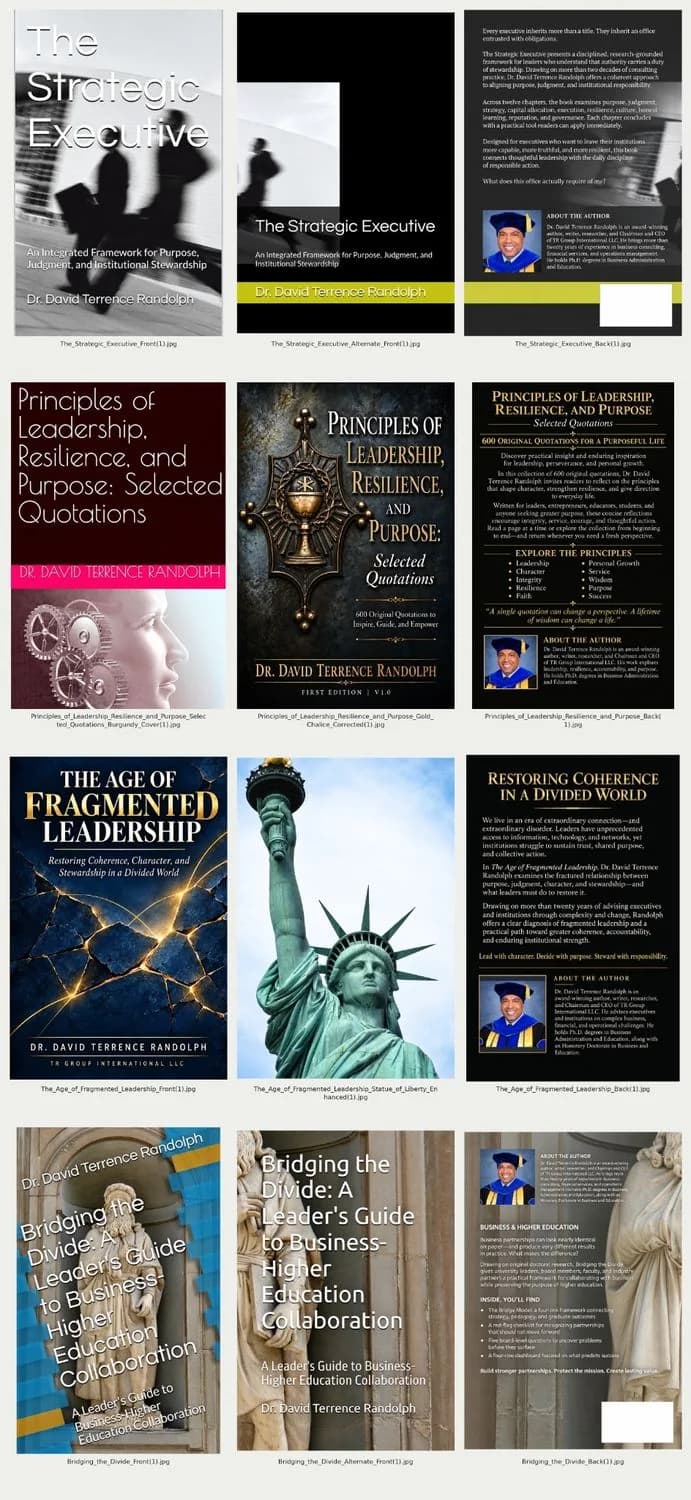
My four published books explore different dimensions of leadership while sharing a concern for responsible influence. Together, they invite readers to examine how purpose, judgment, collaboration, resilience, and stewardship shape the choices people make.
Principles of Leadership, Resilience, and Purpose: Selected Quotations
This collection brings together 600 quotations around themes that invite reflection on leadership and personal development. A short passage can become the starting point for a deeper examination of priorities, habits, and responsibilities.
Readers can approach the collection gradually, selecting a quotation and considering how its theme relates to a current challenge. The value of reflection grows when it leads to a specific action: a clearer commitment, a more deliberate conversation, or a change in how a difficult decision is approached.
Bridging the Divide: A Leader’s Guide to Business-Higher Education Collaboration
Business and higher education bring different responsibilities, expectations, and forms of expertise to collaboration. Productive partnerships require attention to those differences alongside recognition of shared opportunities.
This book addresses that relationship as a leadership concern. For readers considering collaboration, an essential question is whether partners understand each other’s objectives and have established a workable basis for progress.
Clear communication, meaningful participation, and realistic expectations give a partnership greater substance than an announcement alone.
The Strategic Executive: An Integrated Framework for Purpose, Judgment, and Institutional Stewardship
Executive decisions connect an organization’s purpose with its allocation of attention and resources. This book brings purpose, judgment, and institutional stewardship into a shared framework for examining that responsibility.
It invites reflection on the relationship between what an organization says matters and what its decisions support. Leaders can use that concern to examine priorities, question assumptions, and consider the consequences of their choices beyond immediate results.
Strategic direction becomes more credible when people understand both its purpose and its practical implications.
The Age of Fragmented Leadership: Restoring Coherence, Character, and Stewardship in a Divided World
Fragmentation becomes visible when messages, decisions, and conduct pull in different directions. People may hear a commitment to collaboration while encountering incentives that reward isolation.
They may hear an emphasis on trust while receiving little explanation for consequential choices.
This book examines leadership through coherence, character, and stewardship. Its themes encourage readers to consider how stated values can be reflected more consistently in everyday practice.
Restoring coherence requires patient attention to the relationship between commitments and behavior, especially when competing pressures make consistency difficult.
Explore my books through TR Group International: https://www.trgroupinternational.com

Speaking Spotlight: Leadership Beyond the Title
My presentation, Leadership Beyond the Title, examines leadership through character, judgment, accountability, resilience, and service. It draws on themes from business consulting, executive leadership, education, research, and organizational strategy.
The central question is direct: When position and recognition are set aside, what remains of the leader? Answering requires attention to the habits through which influence is exercised, particularly when circumstances are uncertain and decisions affect others.
These concerns are relevant to organizations seeking thoughtful discussion about the relationship between leadership expectations and daily practice.
For speaking or consulting inquiries, please visit TR Group International: https://www.trgroupinternational.com
The Work Continues
I receive the 2026 Global Recognition Award in Leadership with gratitude and renewed commitment to my work as an author, writer, researcher, and executive business consultant.
Recognition offers an opportunity to extend the conversation about leadership and make its responsibilities clearer.
The most useful continuation of that conversation occurs in practice. A reader applies an idea to a decision. A team clarifies an unresolved commitment. A leader listens more carefully to a concern that would otherwise remain unheard.
As you reflect on your own responsibilities, consider three questions:
- 01Where does my influence create a responsibility that deserves more deliberate attention?
- 02Which commitment needs clearer ownership, stronger support, or better follow-through?
- 03What am I building today that will remain useful to others tomorrow?
Choose one question and connect it with an action you can take this week. Leadership develops through repeated decisions whose quality can be examined, corrected, and strengthened.
Thank you for your continued readership and interest in The Randolph Report. I look forward to continuing this work with you.
Warm regards,
Dr. David Terrence Randolph
Award-Winning Author, Writer, Researcher, and Executive Business Consultant
Chairman & CEO, TR Group International LLC

The Randolph Report arrives once a month. Earlier issues remain available to read in full.

Prefer to speak directly?
The Report is one way to stay in touch; a conversation is another. Every engagement begins with a single, careful conversation, directly with the principal, with no obligation.
- Telephone
- 747-208-2074
- Coverage
- Greater Los Angeles County